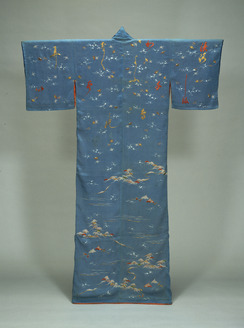
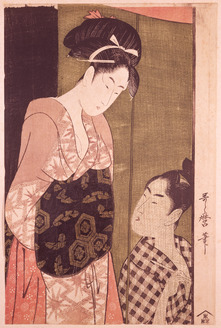
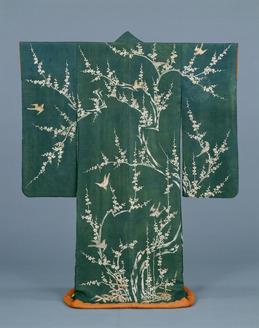
Shin, Gyō, Sō — The Folded Back
真・行・草 ── 畳まれていた背中
A bow used to have three depths.
I bowed today, somewhere. Stepping out of an elevator. At the convenience store counter. On the platform. The angle, in each case, was likely the same — fifteen degrees, perhaps twenty. If there was a difference, it has become too small to register.
There were once three bows. Shin, gyō, sō. Three depths. Three relationships. The angle of the back declared who the one bowing was, and to whom. The form held the social fact.
The gesture is still here. Only the depths have gone missing.
Ogasawara Hyakkajō — the hundred articles of the Ogasawara school, in a manuscript dated to the ninth year of Kan'ei, 1632. The Tokugawa peace was not yet three decades old. The booklet has no cover; only fine cursive on thin washi, instructing how to hand over a long sword, how to carry a letter box, how to bow when one meets a palanquin in the street.
The bow itself is not illustrated. The character rei recurs throughout, but always as a situation, not a posture — which knee on the ground, which hand bearing which object, in which direction. About the angle of the back, the book says nothing.
It did not yet need to. The body came before the book.
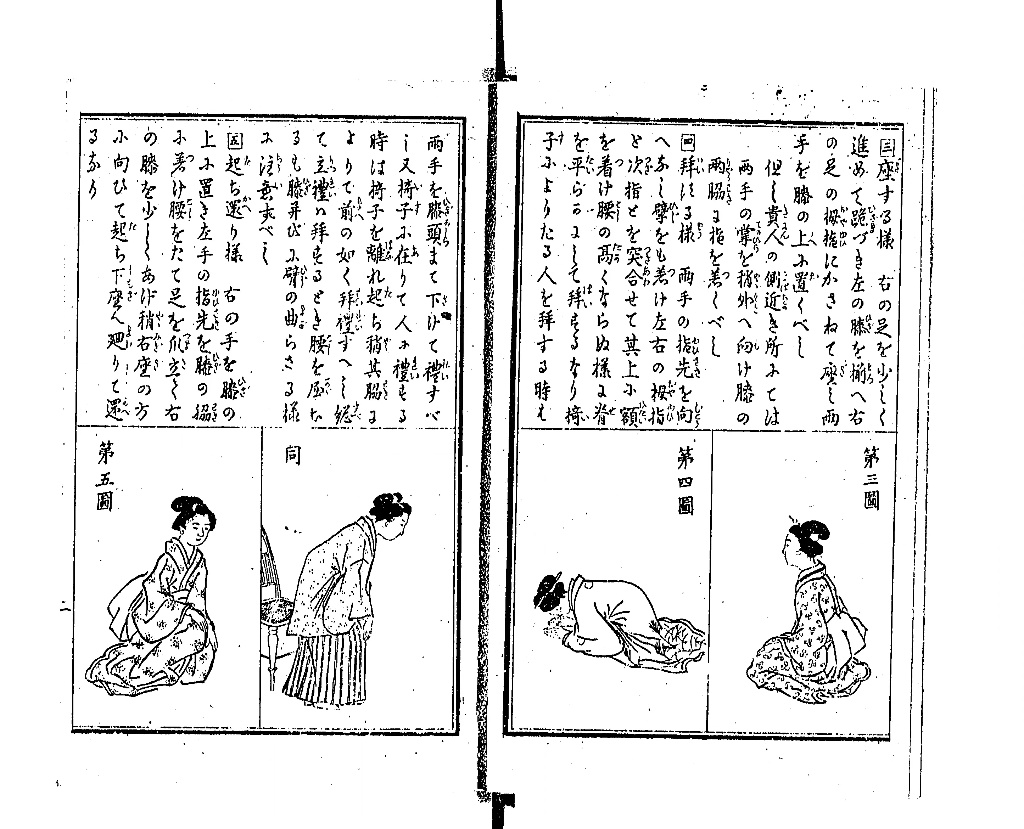
Two and a half centuries pass. In December 1889 — the twenty-second year of Meiji — a small woodblock booklet appears under the imprint of Satō Seizaburō: Ehon Onna Reishiki, the Picture Book of Women's Etiquette. It is no longer a warrior's transcript. It is sold to households for the instruction of girls.
Open it, and there are illustrations: how to sit, to stand, to walk, to open a fusuma, to bow. Every figure is drawn in kimono. The fall of the sleeve. The folding of the hem. The placing of the knees. The book repeats them in word and picture. "Let the fingertips of both hands point forward; lower the head; bring the tip of each thumb to meet its forefinger; press the forehead upon them; flatten the back so the hips do not rise. That is the bow."
The book existed because the bow had begun to need to be drawn. The body of the warrior had become illegible without a picture.

1934. The editorial office of Shūbunsha publishes a manual whose title carries a word not yet found in earlier etiquette books: gendai-shiki, “modern-style.” Aisatsu no Kotobazukai o Kihon to Shitaru Gendai-shiki Reigi-sahō — Modern-Style Etiquette, Based on Forms of Greeting.
Inside, the table of contents places kimono formal dress and Western formal dress side by side. Japanese cooking and Western cooking, side by side. A page on greeting the visitor in the parlour is followed immediately by a page on greeting the visitor in the Western-style room. “How very kind of you to come” — the same phrase, in either dress.
The bow is still alive at this point. But it is no longer threefold. Shin, gyō, and sō are no longer distinguished. There is “polite” and there is “casual,” and not much else. The graduation on the back has become coarse.
When the Western figure entered the page, something quieter was also happening. Once the sleeve was shortened, the handling of the sleeve was gone. Once the obi was set aside, the upper body had nothing to fold against. The garment that had been the grammar of the gesture had been quietly removed.
Original text
拜の様 ── 両手の指先を向ふへなし、頭をも下げ、 左右の拇指と次指とを突き合せて、 其の上に額を着け、 腰の高くならぬ様に背を平らになして 拜するなり。
On the form of the bow — let the fingertips of both hands point forward; lower the head; bring the tip of each thumb to meet its forefinger; upon them, set the forehead; flatten the back so the hips do not rise. That is the bow.
— 絵本女礼式, 佐藤清三郎 刊, 明治二十二年(1889)
What is forgotten
The three depths — shin, gyō, sō — and behind them, the older idea that a relationship is something one shows by the angle of one's back.
And the body that made those depths possible: a waist held by an obi, a hand weighted by a sleeve, a knee folded under a hem.
That the kimono was set aside, and that the bow lost its grades, are not two events. They are one forgetting, seen from two sides.
Glossary
- Shin-rei — the deepest bow. The forehead is lowered until it rests on the hands.
- Gyō-rei — the intermediate bow. Both hands lower to the knees.
- Sō-rei — the light bow. The shallowest grade, close to a nod.
- Shikkō — to advance across tatami on one's knees, without standing.
- Hai — the highest grade of bow, offered to deities, ancestors, and lords. The head is brought close to the ground.