The Summers We Slept Inside Hemp
麻のなかで眠った夏
On the kaya, and the cloth that shared its fibre
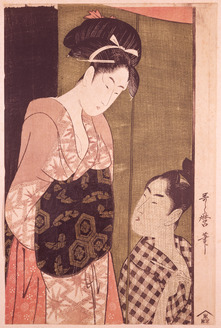
Four iron rings — kan — were driven into the ceiling of the sleeping room. Small metal hoops. In summer, the mother or the grandmother would thread a hemp cord through them, and a pale green wall would rise on four sides. The smell of hemp filled the room. The children, still in their nightclothes, threw themselves down inside. Inside the kaya.
Mosquito nets were hemp. Ōmi province — particularly the country around Hachiman — wove most of them. A wall of pale yellow-green. In a tatami room sinking into dusk, this was the only plant-colour. The tassels at the four hanging corners were always red. In the evening the house divided in two. Inside the net, outside it. A child took in the difference at once.
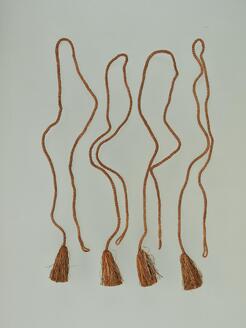
What threaded through the kan was a red cord. One loop went over the iron ring in the ceiling; the other was knotted to a corner of the net. That alone raised the walls. The cord was always red. Why red, no one quite said. When summer ended, cord and net together were folded down into the chest of drawers. Until the next rainy season, the cord was not seen in the house. Only the rings remained, in the ceiling.

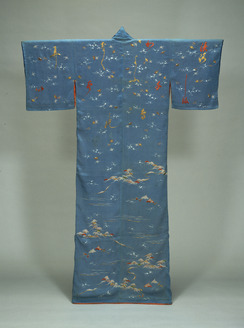
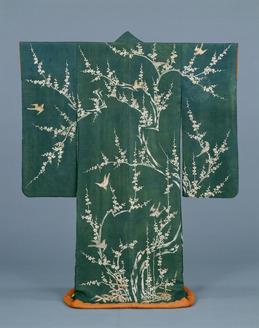
The same fibre also clothed the body. Jōfu — the finest grade of summer hemp — came out of Echigo, Ōmi, Miyako, Yaeyama. Thin enough to let the light through, yet stiff with sizing. Sewn up, it became katabira, the unlined summer kimono, worn directly against the skin. The nightclothes too were often a hemp yukata. On a summer night, hemp around the bed and hemp on the body. The same plant came into the house twice.
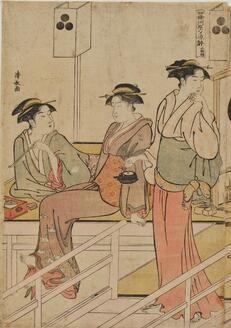
Outside the net, summer had its other practices. The kayaribi — a low smouldering fire of mugwort or fresh sugi needles, built on the earthen floor, its smoke meant to drift through the rooms. A wooden tub set out in the garden — gyōzui — into which children and women lowered themselves while a little brightness still hung in the air. The smell of the house after the evening meal became the smell of the night. Hemp, smoke, water.
Original text
蚊のいと細声に名のりて、顔のほどに飛びありく、羽風さへ、その身のほどにあるこそ、いとにくけれ。
And the mosquito — announcing herself in that thin, small voice, circling close against one's face, the very wind of her, scaled to her own body, no larger — is utterly hateful.
— 枕草子, 清少納言, 平安時代・11世紀初頭
Major Kaya Production Centre
Hachiman, Ōmi province (present-day Ōmi-Hachiman, Shiga).
The Four Centres of Jōfu
Echigo, Ōmi, Miyako, Yaeyama.
Origin of the word katabira
From kata-bira — “one-sided cloth”, that is, an unlined garment.
Materials for the kayaribi
Mugwort (yomogi), green sugi needles, kaya wood shavings.
What is forgotten
The body's memory of sleeping inside hemp. A house of tatami, paper, hemp; summer thick with the smell of plants. The iron rings that waited in the ceiling all year, for summer. The particular way the net was folded back into the chest of drawers in autumn. The moment a child ran inside.
Glossary
- A small iron hoop driven into the ceiling. The cord of the kaya was threaded through it.
- A hemp net hung from the four corners of the sleeping room. Typically dyed pale yellow-green.
- Pale yellow-green. The canonical colour of the kaya.
- The finest grade of summer hemp cloth — from Echigo, Ōmi, Miyako, and Yaeyama.
- An unlined summer kimono, usually of hemp.
- A low fire of mugwort or sugi needles, smouldered so the smoke would drive off mosquitoes.