Letter No.01
Letters Worn, Not Sent
読み手のいた頃
The age when cloth was read by those who could read it
Yuji Kuno / 久野雄治
There was a time when a pattern on a sleeve was not decoration. It was a word.
A woman would pass on the street, and a single character embroidered at her hem would lift, in the eye of someone who knew, into the next line of a poem, and the next, and the rest of the verse would arrive unspoken between them. The cloth carried what the voice would not. The reader supplied the silence.
The cloth is still here. Some of it sits behind museum glass in Ueno, the silk gone the colour of weak tea, the gold thread tarnished but legible. What has gone is the other half — the eye that could read it without thinking.
Among the hundred poems schoolchildren once memorised before they understood them, there is one by Kawara no Sadaijin, written in the ninth century.
For whom, then, has my heart begun to tangle — dyed in the disordered patterns of Shinobu cloth from the far north — if not for you?
Shinobu-mojizuri was a real fabric. It was dyed in Michinoku by pressing cloth against rocks overgrown with a fern called shinobu, taking up the impression in irregular, broken lines. The pattern looked like writing that had run.
The word shinobu also meant to hide one's feelings, to endure them in silence. And the word somu — to dye — was also the word for to begin.
So the poem says, in the same breath: my heart is dyed, my heart has begun, my heart is in the tangled pattern of the northern cloth, my heart is hidden, my heart is enduring. One image, doing the work of five verbs. The pattern was not a metaphor for the feeling. The pattern was the grammar in which the feeling could be said at all.
A reader in the tenth century would have known this without being told.
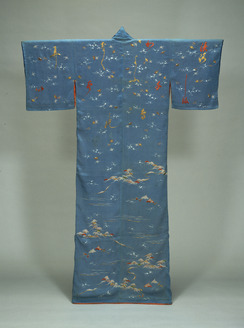
In the Tokyo National Museum, item I-1286, there is a woman's kimono from the eighteenth century. Pale blue silk crepe. Along the hem, a stretch of shore, and over the shore, plovers. Between the birds, in cursive script done in embroidery, a poem by Minamoto no Kanemasa, written six hundred years before the kimono was sewn.
Crossing to Awaji Island, the cries of the plovers — how many nights have they kept him from sleep, the watchman of the Suma barrier?
The barrier of Suma is where the exiled prince in The Tale of Genji lay awake in his loneliness. Every educated reader of the eighteenth century knew this. To wear the poem was to wear the loneliness with it, and the Genji chapter folded into the loneliness, and the centuries folded into the chapter.
The woman who owned this kimono is not recorded. We do not know whom she put it on for, or whether she put it on for anyone at all. The cloth tells us only that she chose, from the entire repertoire of Japanese verse, a poem about a man who could not sleep.
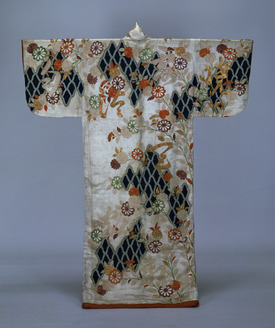
A few cases over, the same museum holds another eighteenth-century kimono. White figured satin, scattered with chrysanthemums and netting. Among the flowers, Chinese characters drift across the cloth — six down the front, four down the back.
Noon. Wind. Smoke. River. Light. Fragrance. Dew. Dawn. Palace. Scent.
They are not a sentence. They are pulled from somewhere — a Tang poem, perhaps a couplet from Wakan Rōeishū — and the source has not been identified. Not by the museum, not by the scholars who have catalogued the collection.
Two things are true at once. The cloth has not changed. The Chinese poem it was cut from has almost certainly survived somewhere, in some anthology, on some shelf. What has gone is the third thing — the woman who, two hundred and fifty years ago, glanced at this garment and knew, in the time it takes to draw a breath, which poem she was looking at.
The cloth is not unreadable. We are.
Original text
陸奥のしのぶもぢずり誰ゆゑに乱れそめにし我ならなくに
Michinoku no shinobu mojizuri tare yue ni midaresomenishi ware naranaku ni
For whom, then, has my heart begun to tangle — dyed in the disordered patterns of Shinobu cloth from the far north — if not for you?
— 『古今和歌集』巻十四・恋四・724, 河原左大臣(源融、822–895), 九世紀
The age of moji-chirashi
Kimono scattered with characters from poems flourished from the late seventeenth into the eighteenth century — the Genroku and Kyōhō eras. Embroidery, shibori, and gold leaf carried the script.
The source texts
The poems drawn upon came from a known canon: Kokin Wakashū, Shūi Wakashū, Hyakunin Isshu, and Wakan Rōeishū. To recognise one fragment was to know which book it had come from.
Who the readers were
Samurai-class women, the wives and daughters of prosperous townsmen, the courtesans of the licensed quarters. Literacy in classical verse was assumed within these circles.
Reading as part of dressing
A garment was not only worn; it was read. The act of dressing presumed an audience that could decode the cloth at a glance. The garment failed if no one in the room could read it.
What is forgotten
The eye that, glancing at a single character on a sleeve, could supply the rest of the poem in silence.
Glossary
- moji-chirashi文字散らし
- "Scattered characters." A design technique in which characters from a known poem are distributed across a garment, to be reassembled in the reader's mind.
- rinzu綸子
- Figured satin silk. The smooth, lustrous ground favoured for elaborately decorated kimono from the late seventeenth century onward.
- nuihaku縫箔
- A combined technique of embroidery (nui) and applied gold or silver leaf (haku). Standard for high-end Edo-period garments.
- mojizuriもぢずり
- A dyeing method from Michinoku in which cloth was pressed against ferns growing on rock, taking up broken, irregular impressions. Synonymous, in poetry, with disorder of the heart.