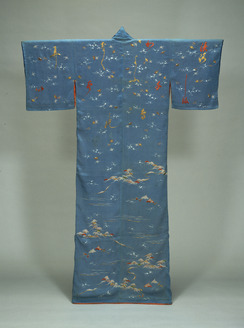
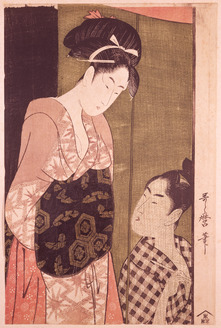
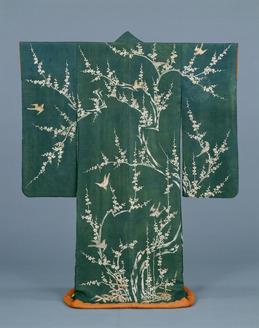
Letter No.00
Nagajuban, or the Layer That Shows
長襦袢、あるいは見えてしまう一枚
What Western dress has no room for — and the day an official notice struck it out.
久野雄治
Western dress has nothing that answers to the nagajuban. What is underneath is hidden; what is on top is shown. Two layers, and the matter is settled.
The kimono keeps one more between them. A sliver at the cuff, an instant at the hem, the han-eri standing up along the collar. Not a layer worn to be shown to anyone — a layer for the moments when it shows in spite of itself. A picture was painted on it because the person wearing it knew it was there.
On the seventh of July, 1940, a government notice came down on that one layer.
In the thirty-second year of Meiji — 1899 — the Mitsui Drapery issued a single sales catalogue. Natsugoromo: summer clothes.
Turn to the page of nagajuban and there are no product names. In their place stand kotobagaki, the captions one finds written beside a painting: Flower Cart. Peony. Butterfly. Double Cherry. The prices are set small at the edge; the text itself runs in the cadence of short verse.
One line reads:
Double cherry, scattering senseless as snow at the dead of night — and even the moon dyed clear across.
It is the midnight moon being dyed. Not onto the outer robe, but onto the nagajuban, the layer that was not meant to be seen.
A draper was selling a night scene on a garment that might, at most, be glimpsed. "All of these," it says at the foot of the page, "are patterns of pure refinement."
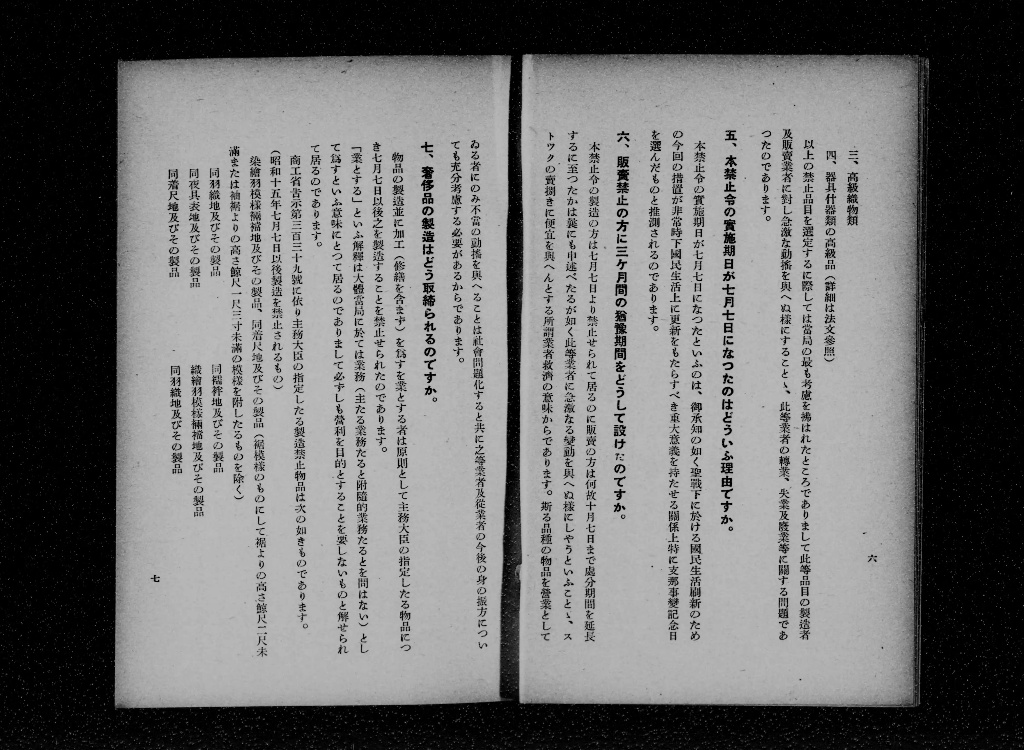
Forty-one years later. Ministry of Commerce and Industry Notice No. 339.
In the column of goods forbidden to manufacture, the nagajuban stands fourth, gathered under a single character: 同 — ditto, the same as above.
What in 1899 had been called out one by one — Flower Cart, Butterfly, Double Cherry — was here only 同. Same as above.
On why the notice was set to take effect on the seventh of July, the official commentary allows itself one sentence: that the anniversary of the China Incident, it is surmised, was deliberately chosen. Three years, by then, from the Marco Polo Bridge.
The notice carries a proviso. A pattern is exempt if it rises less than two shaku from the hem, or less than one shaku three sun from the lower edge of the sleeve — measured in kujira-jaku.
The kujira-jaku is a rule used nowhere but in the cutting of kimono. On the tailor's table, at the wholesaler's accounting desk, a craftsman lays cloth against these graduations.
On that scale, the state drew a line.
Up to here is not luxury. From here on, it is. Two kujira-shaku: about seventy-six centimetres.
The notice carries an exception as well. Against an application, the competent minister or a regional governor might grant a special licence — for eight kinds of thing, set down in order:
(a) goods for export; (b) things for which a technique had to be preserved; (c) supplies for foreign embassies; (d) articles used in the formal rites of shrines and temples; (e) stores for ships on foreign routes; (f) materials for scholarship, testing, research; (g) costumes for Noh, Kabuki, and the dance; (h) supplies for the military and for the press, the news agencies, the camera.
The costumes of Noh, of Kabuki, of the dance stand in that list beside goods for export, beside the supplies of embassies, beside the rites of shrines and temples.
From the everyday nagajuban the dyed eba disappeared. What was left — only what had passed through an application — was left for the stage alone. If the eba nagajuban is now something one sees mostly in the world of the classical theatre, one of its beginnings is here.
Original text
染繪羽模樣裲襠地及びその製品、同着尺地及びその製品(裾模樣のものにして裾よりの高さ鯨尺二尺未滿または袖裾よりの高さ鯨尺一尺三寸未滿の模樣を附したるものを除く)同羽織地及びその製品同襦袢地及びその製品同夜具表地及びその製品
Cloth in dyed eba pattern for the uchikake, and products thereof; likewise cloth for kimono lengths and its products (excluding a hem pattern less than two kujira-shaku in height from the hem, or less than one shaku three sun from the sleeve-hem); likewise haori cloth and products; likewise juban cloth and products; likewise bedding-cover cloth and products.
— 商工省告示第三百三十九號, 昭和十五年七月七日施行 / 収録:商工経営研究会編『問答式解説 七・七奢侈品禁止令』昭和十五年(NDL PID 1463790)
Notice
Ministry of Commerce and Industry Notice No. 339
In force
7 July 1940 (Shōwa 15)
The line
Excluded: under two kujira-shaku from the hem, or one shaku three sun from the sleeve-hem
Licensable
Costumes for Noh, Kabuki, and the dance, plus seven other categories
What is forgotten
The sense itself — that a garment can exist not to be shown, but for the moments when it shows.
The day a nagajuban that had been given names was gathered under the one character 同.
That no one remembers that character.
Glossary
- nagajuban長襦袢
- The layer worn beneath the kimono, made on the understanding that it will be seen — at the cuff, at the hem, at the collar.
- eba絵羽
- A pattern dyed so that it carries across the seams as one continuous picture.
- kujira-jaku鯨尺
- The rule used in the cutting of kimono. One shaku is about 37.88 cm.
- Shashihin-tō Seizō Hanbai Seigen Kisoku奢侈品等製造販賣制限規則
- The wartime control regulation in force from July 1940, known as the 7-7 Prohibition.
- uchikake裲襠
- The uchikake, the bridal overrobe — one of the items forbidden by the notice, listed beside the nagajuban.